Platon Sudoku · Sudoku Study
Multi-Coloring · Step-by-step example
Two separate coloring components for one digit each have opposite A/B states. A candidate from each component sees the other, creating a cross-component conflict. Remove the digit from a target that sees a candidate in each opposite alternative.
On this page
Recognize the pattern
Two separate coloring components for one digit each have opposite A/B states. A candidate from each component sees the other, creating a cross-component conflict.
How to find it
Build two separate strong-link networks, mark their A/B states, and find candidates from different components that see each other.
What it allows
Remove the digit from a target that sees a candidate in each opposite alternative.
Avoid the mix-up
Do not merge the two components into one color chain. Verify each component’s strong links and the target’s sight of both alternatives.
Step-by-step example · Two components
This example starts from a saved intermediate position. Its candidates include earlier logical eliminations; they are not fresh automatic notes.
Blue: evidence. Green: conclusion. Crossed-out digits: eliminated candidates. R1C1 means row 1, column 1.
Step 1 · This is Multi Coloring
This walkthrough covers HoDoKu Multi Colors Type 1: two colored components contain a cross-component conflict. Candidate 6 forms those two separate coloring components. Within each component, round A and square B are opposite states. Keep the target R7C2=6 in view.
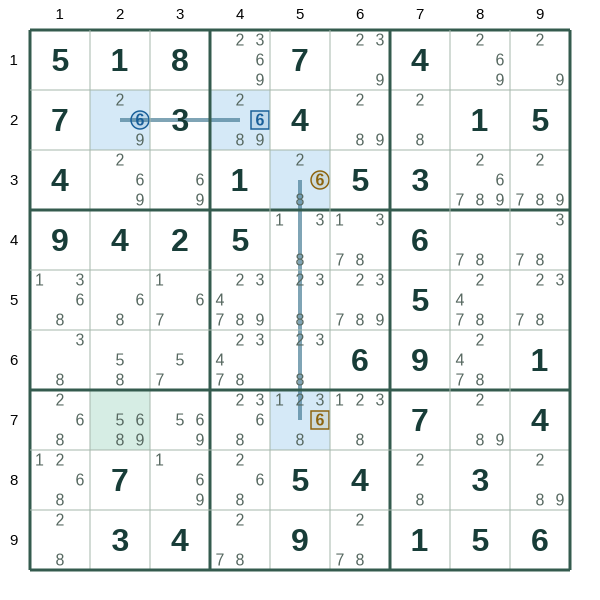
● 1A: R2C2=6
■ 1B: R2C4=6
● 2A: R3C5=6
■ 2B: R7C5=6
Step 2 · Inspect component 1
Coloring component 1: round A = R2C2=6; square B = R2C4=6. A and B are opposite states, and every strong link joins them within this component.
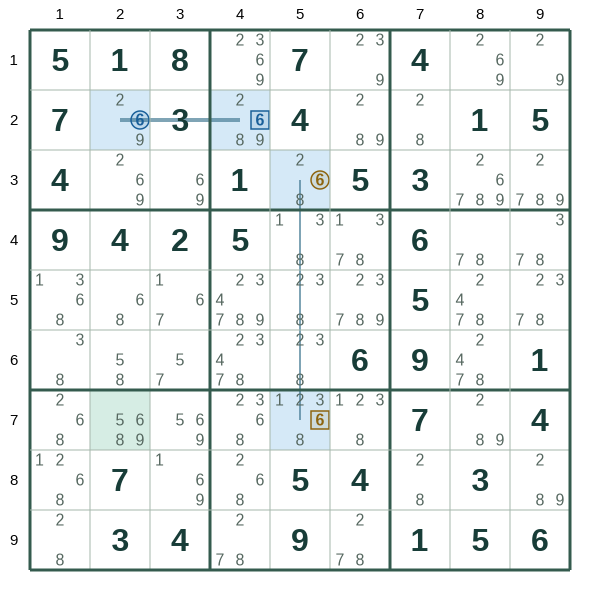
● 1A: R2C2=6
■ 1B: R2C4=6
● 2A: R3C5=6
■ 2B: R7C5=6
Step 3 · Inspect component 2
Coloring component 2: round A = R3C5=6; square B = R7C5=6. A and B are opposite states, and every strong link joins them within this component.
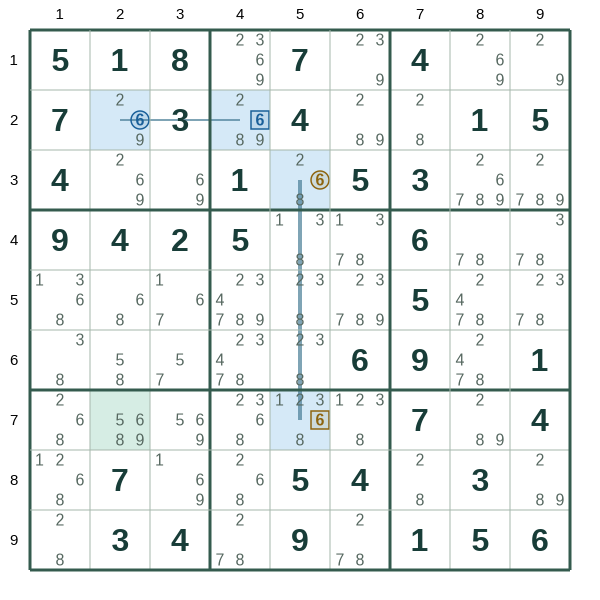
● 1A: R2C2=6
■ 1B: R2C4=6
● 2A: R3C5=6
■ 2B: R7C5=6
Step 4 · Find a cross-component conflict
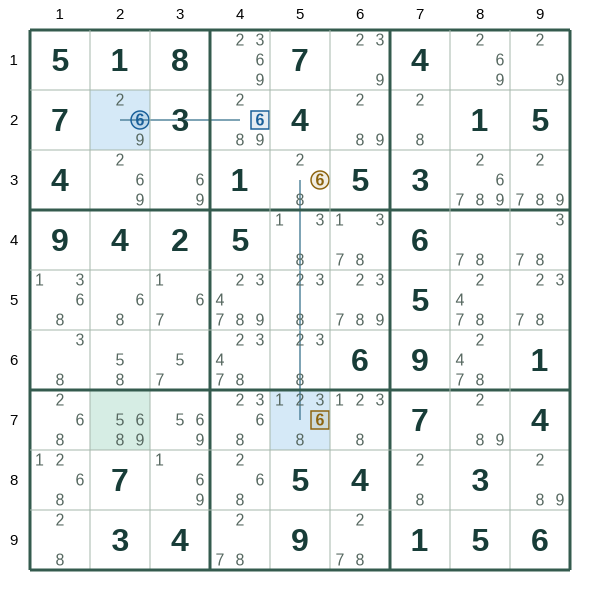
R2C4=6 and R3C5=6 belong to different components but see each other in box 2. They cannot both be true.
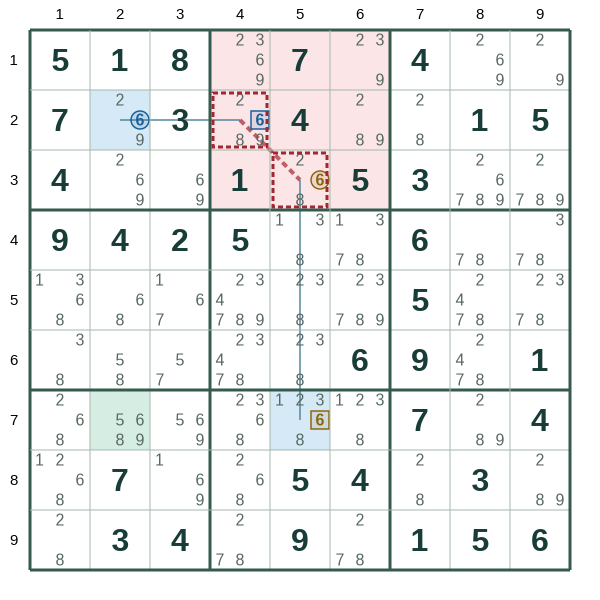
● 1A: R2C2=6
■ 1B: R2C4=6
● 2A: R3C5=6
■ 2B: R7C5=6
Step 5 · At least one opposite state is true
Since the conflicting states cannot both be true, at least one opposite state—R2C2=6 or R7C5=6—must be true.
● 1A: R2C2=6
■ 1B: R2C4=6
● 2A: R3C5=6
■ 2B: R7C5=6
Step 6 · The target sees both alternatives
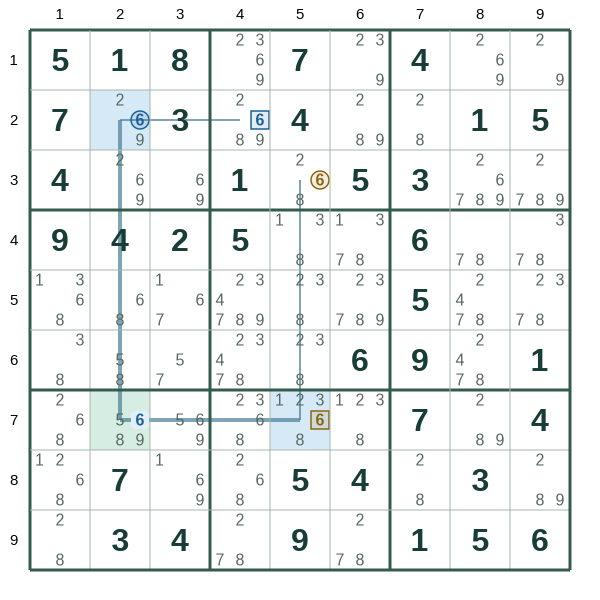
R7C2=6 sees R2C2=6 and R7C5=6. Whichever opposite state is true excludes the target.
● 1A: R2C2=6
■ 1B: R2C4=6
● 2A: R3C5=6
■ 2B: R7C5=6
Step 7 · Remove the target candidate
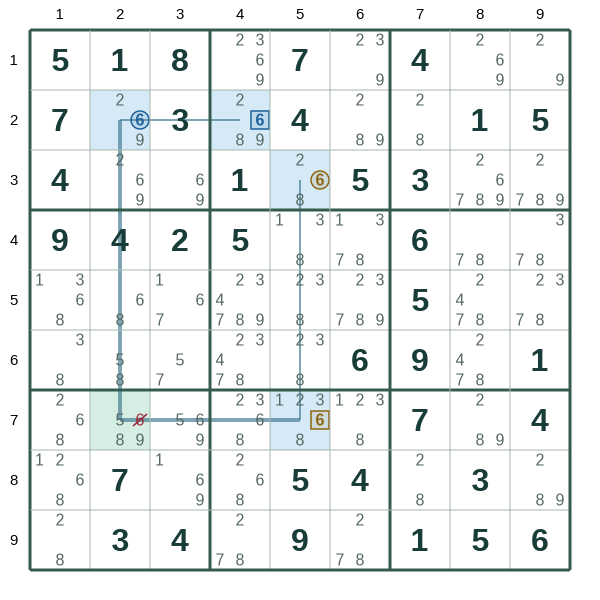
Remove R7C2=6.
● 1A: R2C2=6
■ 1B: R2C4=6
● 2A: R3C5=6
■ 2B: R7C5=6
What it allows
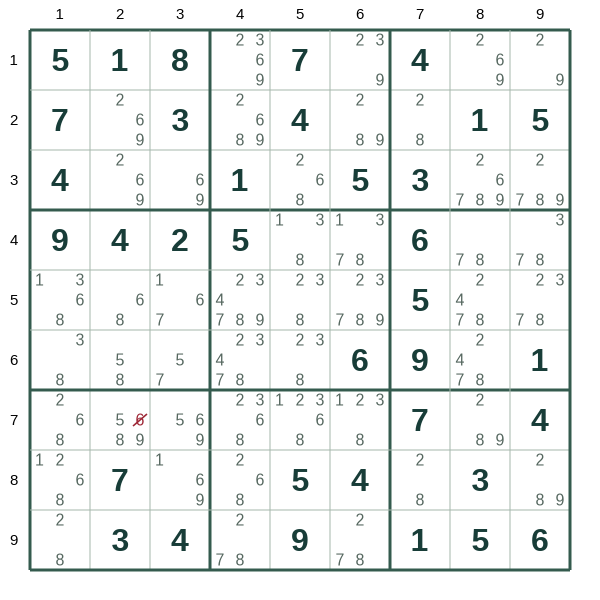
Remove R7C2=6.
Practice
This course is adapted from Platon Sudoku App. Read the complete example here, then continue learning and practising in the app.
View on Google Play